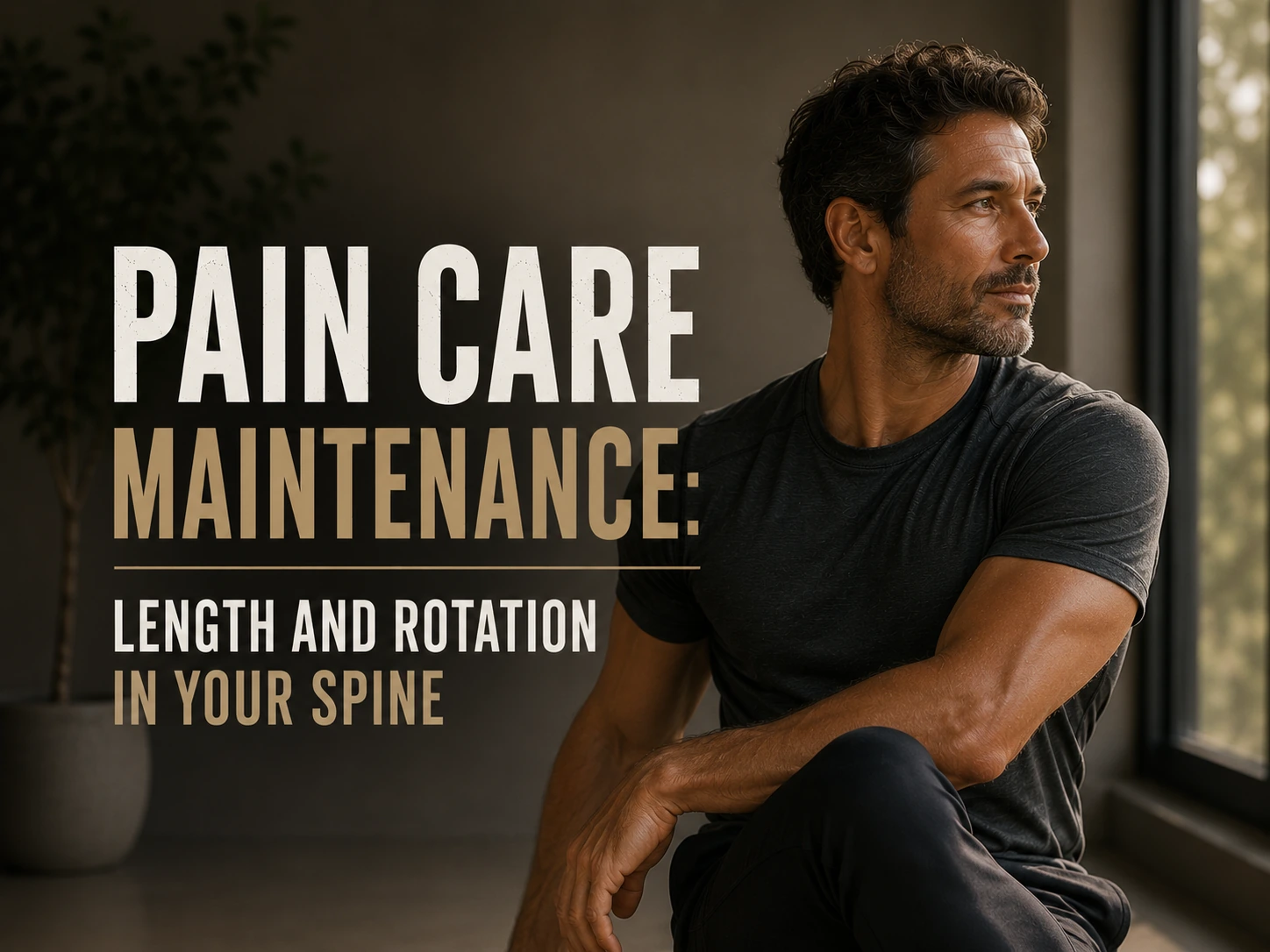
Length and Rotation in Your Spine
Now, I know I said we would do elbows and forearms this week. However, you’ve been doing so well, I decided to give you the first part of the torso and back instead!
We will bring our focus down to the upper extremities to tackle the elbows and forearms next week. Then, we will be fully prepared to handle the ultimate challenge: Part two of the torso and back via the spine.
This week, we are shifting our attention to the central axis of your entire body.
When we sit or experience daily stress, the gravity and compression on our vertebrae squeeze the life out of our spinal discs and lock up the surrounding myofascial sheets.
Today, we are going to decompress the spine and unlock the deep rotational layers of the torso.
Step 1: The Skyward Spire (The Spine)
This first movement targets the spine to undo the heavy crushing forces of gravity.
The Setup:
Stand comfortably and lightly with your feet firmly on the ground and your toes pointing straight forward.
The Cue:
Focus on lengthening your spine without moving your body. Lengthen your spine as though you are attempting to add inches to your height and grow taller. Imagine you are trying to make yourself physically grow inches taller.
What This Does:
This movement creates natural decompression between each vertebra, hydrating your spinal discs, opening up crowded nerve pathways, and releasing chronic tension in the deep postural muscles that hold you upright.
The Guardrail:
Do not tense up any other part of your body. Keep your neck and head straight and upright. Do not lift your chin. Keep your shoulders relaxed and down the whole time. Allow any tension you feel to be a pure result of the deep fascia lengthening, not because of any extra muscular force you are providing. Be gentle.
The Breath & Hold:
Maintain a smooth, steady breath. Keep reaching mentally for a count of 10, then gently relax.
What to Notice:
Pay close attention to the unique, subtle lengthening sensation in your spine, your back, and radiating into the rest of your body.
Repetitions:
Repeat 2 more times.
Step 2: The Static Twist (Upper Back & Torso)
Now, we are targeting the deep rotational fascia of the upper back and torso.
The Setup:
Stay in the exact same standing position with your feet flat.
The Cue:
Raise your arms up to the sky with your palms facing forward. While keeping your palms facing forward, slowly turn your upper back toward the left without moving your palms and without moving your hips. Your belly button and palms should remain facing forward. This will give you very minimal movement. Hold for a count of 10 and perform the same movement toward the right.
What This Does:
By anchoring your hips and hands forward while rotating the upper back, you wring out the deep fascial layers of the torso. This stabilizes your core tracking, unloads hidden stress from the lower back, and improves your overall breathing capacity by opening the ribcage.
The Guardrail:
Just like the first exercise, do not add any extra physical gripping or muscle tension. Less is more here. Let the visual analogy do the work.
The Breath & Hold:
Maintain a smooth, steady breath. Keep holding the rotation for a count of 10, then gently relax.
What to Notice:
Notice what you feel deep inside your lower back, your glutes, your pelvic tracking, and the outer edges of your hips.
Repetitions:
Repeat 2 more times on each side.
Step 2: The Pocket Drop (Shoulder Isolation) Roof Reach
Now, we are doing the exact opposite. We are fixing the neck in place and isolating the shoulder blades (the scapulae) to slide down the back
The Setup:
Stay in the exact same seated position with your feet planted. Place your hands on your thighs with your palms facing flat down.
The Cue:
Put your shoulders in your pockets! Imagine you are trying to physically slide your shoulder blades straight down into your back pockets.
The Guardrail: Do not elongate your neck
while you do this. Keep your head completely neutral. This is purely a shoulder movement.
The Breath & Hold
Breathe evenly as you pull down. Hold this downward engagement for a firm count of 10
What to Notice:
Notice the unique tension and release across the top of your back, your shoulders, and your torso.
Repetitions:
Repeat 2 more times.
Wrapping Up
Remember, the goal of myofascial care is never to force or strain. True, lasting release happens when you allow your nervous system to let go of its grip naturally. Your body is incredibly resilient, and by taking just a few minutes today to breathe and visualize this space, you are retraining your posture from the inside out. You are doing fantastic work - keep listening to your body!